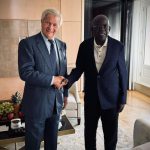
PRESIDENT TINUBU MEETS VINCENT BOLLORÉ IN PARIS ON EXPANDED INVESTMENT IN NIGERIA’S CREATIVE AND DIGITAL ECONOMY
September 18, 2026




January 28, 2026 on Latest News, Press Releases
The Vice President, Senator Kashim Shettima, has restated Nigeria’s commitment to shaping Africa’s future through impact, inclusion, and investment.
And in achieving this, he said the nation is launching and strengthening initiatives such as the Business Coalition for Education and the Women and Youth Financial and Economic Inclusion Platform.
Speaking on Wednesday during the Africa Social Impact Summit High-Level Policy Engagement, held at the Banquet Hall of the Presidential Villa, Abuja, the Vice President noted however that “government alone cannot solve Africa’s development challenges.”
Senator Shettima, who was represented at the event by his Technical Adviser on Women, Youth Engagement, and Impact, Hajiya Hauwa Liman, said, “Beyond Nigeria’s commitment to shaping Africa’s future through impact, inclusion, and investment, this convening of the Africa Social Impact Summit (ASIS(, held in partnership with Sterling One Foundation and our local and global collaborators, must be more than an exercise in social relations.
“It must serve as a platform where intent is converted into execution, where dialogue matures into decision, and where partnerships are forged with outcomes firmly in view.”
VP Shettima pointed out that Nigeria has never taken the potential of ASIS and its promise for granted, recalling that over the past four editions, the summit has evolved “into one of Africa’s most consequential platforms for development dialogue.
“We do not need a lecture on why this engagement matters. None of us doubts its relevance, because all of us here share the same aspiration: to build platforms of execution strong enough to carry the immense potential of this continent into lived reality,” he added.
The Vice President observed that while development had been “framed primarily as expenditure,” in the past decades, government’s responsibility at the moment is to reframe it as investment in human capital, productive systems, climate resilience, digital infrastructure, and inclusive markets.
Africa’s future, VP Shettima noted, will not be financed by aid alone but also by “patient capital, catalytic capital, blended finance, and private enterprise deployed at scale and guided by impact.”
In doing so, he said, “Nigeria is positioning itself accordingly. We are strengthening delivery systems across education, health, social protection, agriculture, climate action, digital public infrastructure, and financial inclusion.
“We are reforming institutions. We are aligning incentives. We are building national results architectures not to impress donors, but to serve citizens.”
The Vice President pointed out that while President Bola Ahmed Tinubu “has without doubt begun the work of turning Nigeria’s fortunes around, “no government, however committed, can finance or execute this agenda alone.”
He explained that it is for this reason the nation considers ASIS as “a convening ground for co-investment, co-design, and co-delivery.”
He described the summit as a “space where policymakers sit with CEOs, development partners, entrepreneurs, civil society leaders, and innovators to build solutions together.”
On empowering Nigerian youth, the VP said the Tinubu administration “has expanded opportunities for young people and women in keeping faith with its promise of an inclusive society.
“Our focus on strengthening human capital is unmistakable. But let me be candid. If we fail to stand together, we leave ourselves vulnerable to avoidable setbacks. This is a reminder to our development partners, to our social innovators, to civil society, and most importantly to the young people and women across Nigeria and across Africa. The stakes are too high for fragmentation. Progress demands coalition,” he further stated.
Earlier, the Minister of Budget and Economic Planning, Atiku Bagudu, represented by Dr. Sampson Ebimaro, the ministry’s Director of the International Cooperation Department, said the objectives of ASIS resonate strongly with the Renewed Hope Agenda of President Tinubu, as the federal government continues to translate policy into implementation.
According to him, ASIS 2026 reinforces the need for strong collaboration among government and the private sector. The Minister assured development partners that the government will continue to accelerate the implementation of the Sustainable Development Goals (SDGs) and deepen collaboration for impact within Nigeria and across Africa.
On his part, the United Nations Resident and Humanitarian Coordinator in Nigeria, Mohamed Malick Fall, whose speech was read, highlighted that Nigeria’s commitment to the SDGs remains a key part of the government’s plans.
He added that for Nigeria to meet the SDGs, states must become the primary engines for implementation, even as the country engages in revenue mobilization and deploys resources strategically.
For her part, Mrs. Olapeju Ibekwe, CEO of Sterling One Foundation, said the engagement marks a new chapter in which the Presidency, the Office of the Vice President, the private sector, investors, development partners, and civil society move beyond alignment to cooperation among national and global partners.
She added that the launch of the respective initiatives represents institutional infrastructure for impact, designed not for announcements, but for execution.
A key highlight of the engagement was the launch of flagship, policy-backed initiatives, including the Business Coalition for Education (BCE), the Nigeria Foundational Learning Fund, and the Women and Youth Financial and Economic Inclusion (WYFEI) Nigeria.
Stanley Nkwocha
Senior Special Assistant to The President on Media & Communications
(Office of The Vice President)
28th January, 2026







Big
Default
Small
Nigeria,