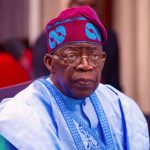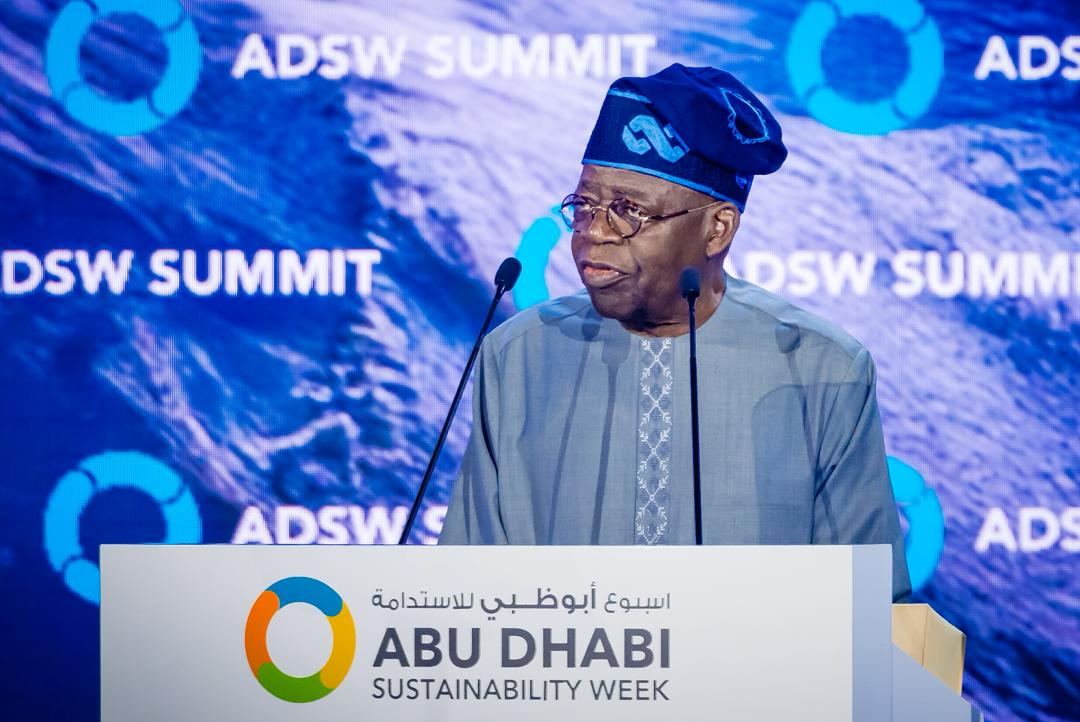
NATIONAL STATEMENT BY HIS EXCELLENCY BOLA AHMED TINUBU, GCFR PRESIDENT OF THE FEDERAL REPUBLIC OF NIGERIA AT THE ABU DHABI SUSTAINABILITY WEEK (ADSW) 2026 “THE NEXUS OF NEXT: ALL SYSTEMS GO” ABU DHABI, UNITED ARAB EMIRATES 11TH – 15TH JANUARY, 2026
H.H. Mohamed bin Zayed Al Nayhan,
Excellencies,
Distinguished Delegates,
Ladies and Gentlemen,
On behalf of the Government and people of the Federal Republic of Nigeria, I wish to thank His Highness Sheikh Mohamed bin Zayed Al Nahyan, the Government of the United Arab Emirates, and the ADSW Secretariat for your continued leadership in convening this important platform.
- The theme of this year’s summit, “The Nexus of Next: All Systems Go,” underscores the urgency and integration required for sustainable transitions across finance, technology, energy, and human capital. The connections between climate and the global economy, health and energy systems, as well as food security must now shape the way we govern and cooperate.
- At this defining moment in history, Nigeria stands with the global community in moving beyond ambition and towards delivery. The nation views the nexus approach as an opportunity to align climate action with energy access, economic growth, job creation, and social inclusion. Sustainable development ensures that all systems (policy, finance, infrastructure, nature, and human capital) move forward together.
- As articulated at COP30 in Belém, Brazil, climate action must be fair. Developing countries require predictable climate finance, accessible technologies, and robust capacity-building support to fulfil their climate commitments without losing focus on advancing their development priorities. This perspective accords with the purpose of this forum, where systems must be ready to mobilize action, strengthen partnerships, and deliver meaningful impact.
- In 2025, Nigeria took major regulatory steps to strengthen our climate governance and sustainability framework. We adopted the National Carbon Market Activation Policy (NCMAP) and launched the National Carbon Registry, to improve our Measurement, Reporting, and Verification (MRV) systems and investor safeguards.
- To translate ambition into impact, we are modernising Nigeria’s energy architecture. The Electricity Act of 2023 now provides for decentralised and inclusive energy delivery. In practical terms, this means sustainable power to rural communities, off-grid health facilities, educational institutions, markets, and underserved populations.
- Nigeria recognises the urgent need to deploy advanced technologies to improve grid efficiency, modernise infrastructure, and accelerate the delivery of sustainable energy to under-served areas. We also recognise that the adoption of Artificial Intelligence (AI) to optimise efficiency is no longer a matter of the future. Therefore, as we work to ensure a stable and reliable energy supply, we are actively seeking partnerships that promote technology transfer, knowledge exchange, and innovation.
Distinguished Delegates,
- Nigeria is views action not as an unwanted burden but as a development opportunity. It is in this spirit that Nigeria has launched a Climate and Green Industrialisation Investment Playbook to unlock 25–30 billion dollars annually in climate finance. The Nigeria Sovereign Investment Authority has launched a $500 million Distributed Renewable Energy Fund, while the World Bank is implementing the 750 million dollars DARES programme, which will expand clean electricity access to over 17.5 million people.
- We are deepening access to green finance. Our Climate Investment Platform targets $500 million for climate-resilient infrastructure, while our National Climate Change Fund aims for a $2 billion capitalisation. The 50 billion naira Sovereign Green Bond issued in 2025 attracted 91 billion naira in subscriptions, while the Lagos State Green Bond was oversubscribed by 97.7%.
- Nigeria’s Energy Transition Plan, (ETP) integrates energy access, climate mitigation, industrial growth, and social development into a single, coherent framework. Achieving net-zero emissions by 2060 while delivering universal energy access.
- Our Pilot Electric Mobility Project is also delivering on national energy efficiency programmes aimed at reducing emissions, lowering costs, and stimulating green industrial development.
- Nigeria is also prioritising critical minerals for a clean energy Among other rear earth minerals in abundant supply in Nigeria, our lithium reserves offer transformative potential for battery production and energy storage. I take this opportunity to invite partnerships that ensure not just extraction of minerals, but local processing and value-addition, thus creating jobs and strengthening industrial capacity at home.
Excellencies,
- The foundation of every modern economy is electricity. As an emerging economy in the Global South, we understand the delicate balance between industrialisation and decarbonisation so that one is not pursued at the expense of the other. We are calling for a fundamental shift in the global financial architecture: a move away from the restrictive requirement of sovereign guarantees, which unfairly penalise developing economies. Instead, the focus should be on blended finance and first-loss capital mechanisms that allow private sustainable capital flows directly into our green projects without further straining national balance sheets.
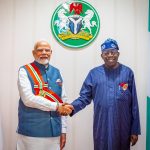
- Nigeria acknowledges its growing strategic partnership with the UAE, particularly in advancing integrated sustainability solutions in renewable energy and clean power investments, sustainable infrastructure and innovative financing, climate-smart agriculture and food systems, technology transfer, capacity building and green innovation.
- We welcome deeper engagement with UAE sovereign investors, development institutions, and private-sector leaders to accelerate flagship projects that reflect the “All Systems Go” approach, where energy, finance, technology, and people work in synergy.
- In this spirit of partnership, it is with great pleasure that I announce that Nigeria and the United Arab Emirates have successfully concluded negotiations on a Comprehensive Economic Partnership Agreement (CEPA). This historic and strategic milestone marks a new era in our bilateral relations. The agreement will deepen trade, unlock sustainable investment, and strengthen cooperation in renewable energy, aviation, logistics, agriculture, digital trade, and climate-smart infrastructure, creating enduring opportunities for our people and businesses.
- As we open this new chapter, Nigeria will proudly co-host Investopia in February in Lagos with the United Arab Emirates. This global convening will bring together investors, innovators, policymakers, and business leaders to turn opportunity into commitment and ideas into investment. We warmly invite our partners to join us and help build the next chapter of sustainable and shared prosperity for Nigeria, Africa, and the world.
- Nigeria is committed to ensuring that transition to a sustainable future is just and inclusive as gender equality, youth empowerment, skills development, and job creation are mainstreamed across climate programmes and initiatives, a people-centered transition remains essential for long-term success.
- Let me close by reassuring the international business community that Nigeria is ready for business. This has been demonstrated by the various reforms we have continued to pursue and in their tangible outcomes being reflected in the economy. These reforms, alongside wider fiscal and monetary measures, are delivering results. Non-oil exports have grown by 21 percent, supported by a more diversified base of products. Capital importation has risen and Nigeria now has over 50 billion dollars in investment commitments across key sectors. We are ready to work with partners across the world to ensure that the next era of development is not only green and inclusive, but just and enduring.
- Thank you.
Bola Ahmed Tinubu, GCFR
President, Commander-in-Chief of The Armed Forces,
Federal Republic of Nigeria